Short answer
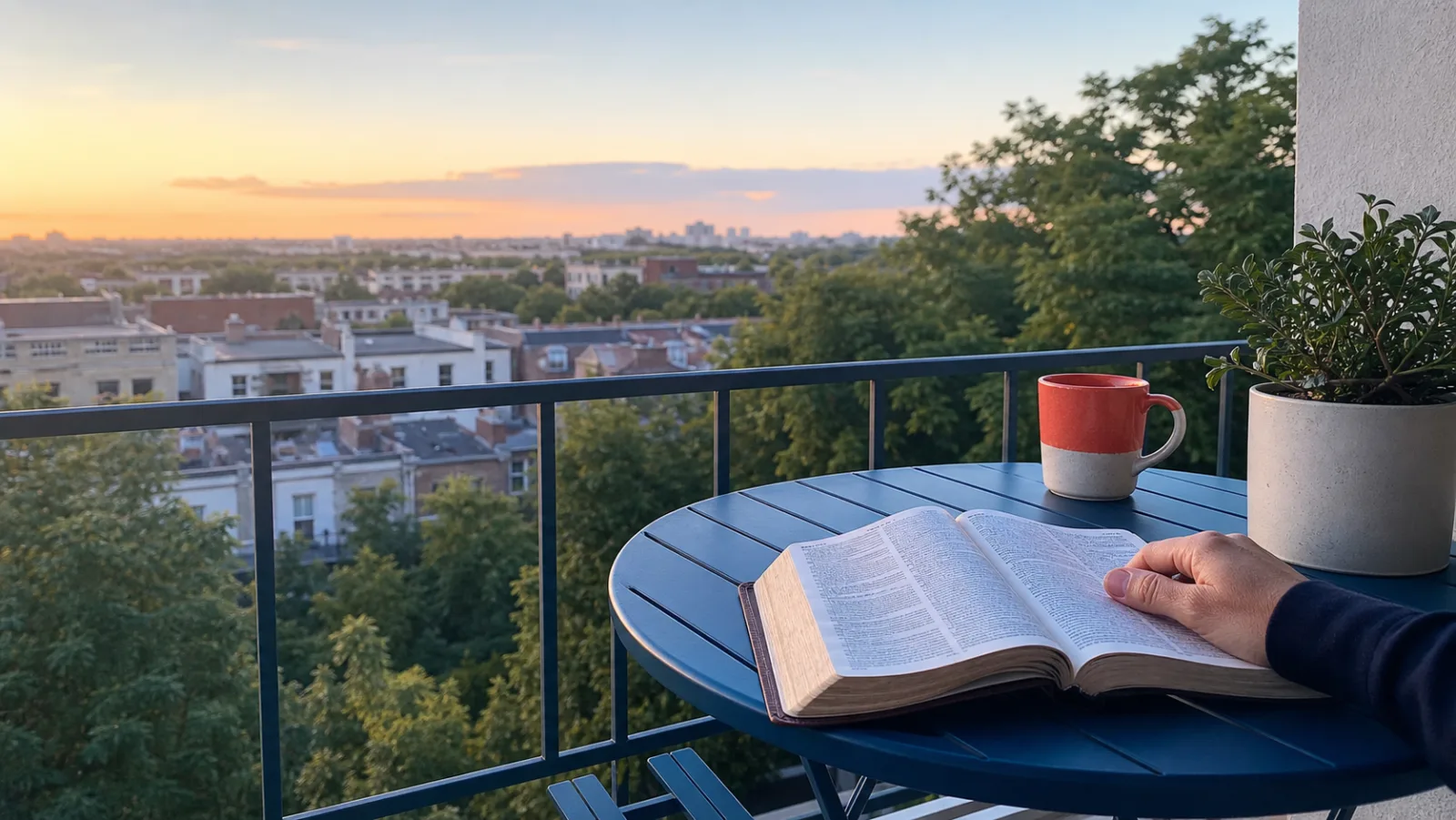
Psalm 121 is the second of the fifteen Songs of Ascents, Psalms 120 to 134. The King James Version heads it "A Song of degrees" and names no author. A speaker looks at the hills and, in the Hebrew, asks where help will come from. The answer is "My help cometh from the LORD, which made heaven and earth." Then a second voice takes over and repeats one Hebrew verb, keep, six times. The psalm promises keeping, and the commentators quoted below read that promise as holding even on a road with sunstroke and robbers.
Bring your situation into the conversation
Begin with one honest sentence. Review it here, then send it when it is ready.
How this guide was reviewed
The PrayWithJesus.ai editorial team checked the scripture references, source links, safety language, and product claims on this page. This review is not a pastoral, theological, medical, or clinical endorsement. Source notes appear below so you can check the material directly.
A prayer for someone leaving the house tonight
Lord, I am looking at the hills again, and I know what they cannot do. My help comes from you, who made them.
Keep the one I love on the road tonight. Keep the car between the lines and the mind awake behind the wheel. Keep the foot from slipping on the stairs. You do not sleep, so I can.
Keep the going out and the coming in, this trip and every one after it. If something goes wrong, keep the soul. Amen.
Psalm 121 KJV, all eight verses
Here is the whole psalm in the King James Version, verse numbers included. The King James prints a short heading above verse 1, "A Song of degrees." That heading belongs to the Hebrew text, and the American Standard Version of 1901 renders the same words "A Song of Ascents." No copyright covers the King James text in the United States, so you can print it or read it aloud at a service.
1 I will lift up mine eyes unto the hills, from whence cometh my help.
2 My help cometh from the LORD, which made heaven and earth.
3 He will not suffer thy foot to be moved: he that keepeth thee will not slumber.
4 Behold, he that keepeth Israel shall neither slumber nor sleep.
5 The LORD is thy keeper: the LORD is thy shade upon thy right hand.
6 The sun shall not smite thee by day, nor the moon by night.
7 The LORD shall preserve thee from all evil: he shall preserve thy soul.
8 The LORD shall preserve thy going out and thy coming in from this time forth, and even for evermore.
Read it once straight through before anything below, and watch the pronouns. Verses 1 and 2 say mine and my. From verse 3 on, the psalm speaks to thee and thy, with one line about Israel in verse 4. Someone asks, and someone else answers.
A Song of degrees with no name in its heading
The heading gives a category and no name. That stands out, because the Songs of Ascents name names elsewhere. Four of the fifteen, Psalms 122, 124, 131 and 133, are linked to David in their headings, and Psalm 127 to Solomon. Psalm 121 has neither. Commentators have proposed David or Hezekiah. The Wikipedia summary of the literature calls the psalm anonymous, and the Hebrew heading offers nothing more.
The Hebrew heading has one oddity. The other fourteen read shir hama'alot, a song of the ascents. Psalm 121 alone reads shir lama'alot, a song to or for the ascents. The sources consulted for this page record the difference without explaining it, and it does not change the sense of the psalm.
When it was written depends on what the ascents were. The Mishnah, in Sukkah 5:4 and Middot 2:5, matches the fifteen songs to fifteen Temple steps between two courts, which would make them songs for Levites at worship. Hossfeld and Zenger's Fortress commentary on Psalms 101 to 150 is cited for the pilgrim reading, songs for the festival climb to Jerusalem, and for separate poems gathered under one title after the exile. Michael Goulder tied them to a celebration after Nehemiah rebuilt the walls in 445 BC. D. C. Mitchell argued for the dedication of Solomon's temple.
Older Christian commentators split along the same line. Alexander MacLaren placed the Songs of Degrees in the exile and read Psalm 121 as a man on the flat plains of Babylonia longing for hills he could not see. The Cambridge Bible for Schools and Colleges reads it as a song for pilgrims going up to the feasts, perhaps sung at the point where Jerusalem first came into view. Both readings fit the words. The words do not decide between them.
A trust song for two voices that closes as a blessing
Psalm 121 contains no complaint, which keeps it out of the lament category, and it thanks God for no particular rescue, which keeps it out of the thanksgiving psalms. Hermann Gunkel, who pioneered sorting the psalms by genre, listed pilgrimage psalms, sung on the road to Jerusalem, among his minor types. The Ascents heading puts Psalm 121 in that company. The Cambridge Bible describes it as "inspired by perfect trust" in God's guardianship, and trust is the plainest name for its form.
The form shapes how you read it. C. S. Rodd, in the Oxford Bible Commentary, describes the psalm as a dialogue in which the opening question is answered, possibly by a priest in a temple setting. The Cambridge Bible imagines pilgrims singing to one another in four pairs of verses, one group asking and another answering. Keil and Delitzsch hear one poet who asks and then answers himself, his calmer self speaking back. Each reading is an attempt to explain the same thing, the move from my to thy at verse 3.
Verses 7 and 8 sound like a blessing spoken over someone about to leave. O. Palmer Robertson observes that twelve of the fifteen Songs of Ascents echo the priestly blessing in Numbers 6, whose King James wording begins "The LORD bless thee, and keep thee." The keep in that blessing is the same Hebrew verb Psalm 121 repeats. With Numbers 6:24 open beside it, the closing lines of the psalm are easy to hear as a farewell said at a gate.
Which hills the speaker in verse 1 is looking at
The opening line is where readers part ways, and the parting is old. Albert Barnes set out three options: the hills a person in danger watches for rescue, the heavens as God's high dwelling, or the hills Jerusalem stands on. He chose the third and called the second forced. The Cambridge Bible also reads Zion and rules out an exile gazing toward the distant mountains of Israel. Keil and Delitzsch take exactly that exile reading and compare Daniel praying toward Jerusalem.
A fourth reading turns the line into a warning. Hilltops in Canaan carried shrines, and the prophets said so. Jeremiah 3:23 in the King James reads: "Truly in vain is salvation hoped for from the hills, and from the multitude of mountains: truly in the LORD our God is the salvation of Israel." Ellicott's Commentary for English Readers allows that the psalmist may have had that contrast in mind, and John Gill cites Jeremiah 3:23 for it. Matthew Henry asks whether to depend on the strength of the hills, meaning princes and great men, and answers no.
Verse 2 settles the matter whichever hills you picture: "My help cometh from the LORD, which made heaven and earth." The hills belong to the earth he made. The same title closes Psalm 124 in the King James: "Our help is in the name of the LORD, who made heaven and earth." The Cambridge Bible notes it as a frequent title in the later psalms and reads it as the ground for expecting help.
Verse 3 as a wish, and a keeper who never dozes
In all three public domain translations quoted here, verse 3 is a statement. The King James reads "He will not suffer thy foot to be moved." The Hebrew negative there is al, which usually marks a wish or a prohibition. Ellicott says the Greek and Latin versions were right to read it as may he not suffer. The Cambridge Bible agrees, while noting that some grammarians, with Davidson's Syntax as its example, allow al to carry the speaker's feeling, which is why the Revised Version kept the statement.
On the Cambridge reading, verse 3 is a prayer, may he not let your foot slip, and verse 4 answers it: there is no need to ask, because the keeper of Israel does not sleep. Keil and Delitzsch read the same word as a strong refusal of something impossible. The grammar is small. The effect is large, because the psalm makes room for a person who is not yet sure and lets another voice steady them.
The sleeping god has a history. In 1 Kings 18:27 Elijah mocks the prophets of Baal on Carmel: "Cry aloud: for he is a god; either he is talking, or he is pursuing, or he is in a journey, or peradventure he sleepeth, and must be awaked." The Cambridge Bible connects verse 4 to that scene. Israel's keeper is unlike a sentry who nods off on the wall.
The Psalter also keeps the opposite voice. Psalm 44:23 says to God, "Awake, why sleepest thou, O Lord? arise, cast us not off for ever." The same book that says the keeper never slumbers lets a beaten people accuse him of sleeping. Psalm 121 is the confidence. Psalm 44 is how that confidence sounds after a lost battle, and both were kept in the book.
Sunstroke, moonlight, and the limits of all evil in verse 7
Verse 6 is concrete. Albert Barnes reads the sun line as sunstroke, and the Bible has a case: the boy in 2 Kings 4 who goes out to the reapers, cries "My head, my head," and dies on his mother's knees at noon. The moon line is harder. Barnes lists the theories, from moonlight blamed for eye disease and madness, the root of the word lunacy, to the sudden cold that follows a hot day. He favors the cold. Keil and Delitzsch take harmful moonlight literally. Ellicott leaves the options open.
John Gill's exposition says the line cannot be taken literally, because good people are burned by day and frozen by night, and he names two of them. Jacob tells Laban in Genesis 31:40, "in the day the drought consumed me, and the frost by night; and my sleep departed from mine eyes." Jonah sits under a sun that "beat upon the head of Jonah, that he fainted." Jacob is the man the nation of Israel is named after, and the frost still kept him awake.
Verse 7 is the line that ends up on cards: "The LORD shall preserve thee from all evil." Christian commentators have not read it as a promise that nothing painful will happen. Gill reads it as keeping from the dominion of sin and from final ruin, and says outright that it does not mean keeping from affliction or tribulation. Matthew Henry divides it: God prevents the evil you fear, and sanctifies, removes, or lightens the evil you feel. The second half, "he shall preserve thy soul," is where both rest their reading, and Barnes glosses soul there as life.
Psalm 91 makes the same promise about the foot that Psalm 121:3 makes: "They shall bear thee up in their hands, lest thou dash thy foot against a stone." In Matthew 4:6 the devil quotes those words to Jesus on the pinnacle of the temple and tells him to throw himself down. Jesus answers, "It is written again, Thou shalt not tempt the Lord thy God." A promise of keeping is no dare to step off a ledge, and the Gospel puts that refusal in Jesus' own mouth.
Paul lists what travel did to him in 2 Corinthians 11:26. The verse opens "In journeyings often, in perils of waters, in perils of robbers," and names six more perils after that. Livingstone's mother-in-law, Mary Moffat, wrote to him, when no letters had come from him in Africa for a long time, that she would have clung to Psalms 91 and 121 as promises of bodily safety, but had been taught that "we may not presume confidently to expect them to be fulfilled." Any honest reading of verse 7 has to hold the promise and Paul's list together.
Keep, keeper, preserve: where the King James splits one verb
The Hebrew verb shamar, to keep or guard, appears six times in eight verses. Strong's gives its root sense as to hedge about, as with thorns. The King James renders it keepeth twice in verses 3 and 4 and keeper once in verse 5, then switches to preserve for the three uses in verses 7 and 8. The American Standard and the World English Bible use keep throughout. Ellicott and the Cambridge Bible both recommend reading keep in verses 7 and 8, because the repetition is what holds the poem together.
Verse 1 differs in punctuation, and this time the sense moves with it. The King James reads "I will lift up mine eyes unto the hills, from whence cometh my help," which sounds as if the help comes from the hills. The American Standard reads "I will lift up mine eyes unto the mountains: From whence shall my help come?" The World English Bible reads "I will lift up my eyes to the hills. Where does my help come from?"
Keil and Delitzsch, Ellicott, and the Cambridge Bible all treat the Hebrew word for whence as a question. Ellicott adds that the King James followed the Greek and Latin in turning it into a relative clause. On their reading, the question is real and verse 2 is its answer.
Two smaller differences remain. The Hebrew of verse 1 says mountains, which the American Standard keeps and the other two soften to hills. The divine name, four Hebrew consonants, appears five times in the psalm, and the King James prints LORD where the American Standard prints Jehovah and the World English Bible prints Yahweh. Neither change alters what the psalm claims. The punctuation in verse 1 is the one that changes what a listener hears.
Doorposts, delivery rooms, and Friday evening prayer
Most of the uses involve a threshold. The Cambridge Bible, citing Kitto's Biblical Cyclopaedia, records that observant Jews touch the mezuzah on the doorpost when leaving or entering the house and recite verse 8. Some Jewish families place a copy of the psalm in the labor and delivery room and on a baby's carriage. The Complete Artscroll Siddur places verses 4 and 8 in the prayers of the bedtime Shema.
Christian prayer gives it fixed places too. Catholics pray it at Evening Prayer on Friday of the second week in the Liturgy of the Hours, and it is read at Mass on the 29th Sunday in Ordinary Time, Year C. The Book of Common Prayer assigns it to Morning Prayer on the 27th day of each month. On 17 November 1840 David Livingstone read it, with Psalm 135, to his family at five in the morning before walking to Glasgow to begin the journey to Africa, and William McKie's setting was sung at the Queen Mother's funeral in 2002.
Outside the liturgy, people pick it up at the same kinds of doorways. A daughter driving across the country alone. A son shipping out. A nurse starting a night shift. A parent awake at three in the morning, hearing every sound in the house, who needs to know the watch is being kept by someone other than them. The psalm fits those hours because it was written for a person in motion, and verse 8 is a sentence about leaving and coming back.
It will not do the practical work. If someone you love is traveling into danger, plan the route with them and keep the phone charged. If fear has started to run your days or has kept you from sleep for weeks, that belongs to a doctor or a licensed counselor. If your thoughts turn toward not being here, the Suicide and Crisis Lifeline picks up at 988, by call or text, at no cost and at any hour anywhere in the United States. If the danger is immediate, dial 911.
For what this psalm means in your own life, ask a person with a name. Your pastor, priest, or rabbi knows you and will pick up the phone. This page comes from a software company that no church has approved, and it has no authority to teach. Where your church reads Psalm 121 another way, go with your church.
Questions for reflection
- 1Which hills do I look at first when I need help?
- 2Is my verse 3 a statement today, or still a prayer?
- 3Who answers me the way the second voice answers in this psalm, and whom do I answer that way?
- 4What am I going out to this week, and what am I coming back to?
- 5Where have I been burned by the sun and still been kept?
Common questions
What is Psalm 121 about?
It is a short song for someone setting out. The speaker looks at the hills and asks where help will come from, answers that it comes from the LORD who made heaven and earth, and then hears six lines of assurance built on one verb, keep. God does not sleep, shades the traveler from sun and moon, keeps the soul, and keeps the going out and the coming in for good.
Who wrote Psalm 121?
No one is named. The King James heading reads only "A Song of degrees." Four other Songs of Ascents carry David's name and one carries Solomon's, so the silence here is noticeable. Some commentators have guessed David or Hezekiah. Nothing in the text settles it, and the date is disputed too.
What does "I will lift up mine eyes unto the hills" mean?
Commentators disagree on which hills. Barnes and the Cambridge Bible say the hills of Jerusalem, where God was worshipped. Keil and Delitzsch picture an exile looking toward the mountains of home. Ellicott allows a contrast with the hilltop shrines of Canaan, and Gill points to Jeremiah 3:23, which calls salvation from the hills a vain hope. On any reading, verse 2 gives the answer: help comes from the LORD.
What does "A Song of degrees" mean?
It is the King James rendering of a Hebrew heading that the American Standard Version translates "A Song of Ascents." Fifteen psalms, 120 to 134, carry it. The Mishnah links them to fifteen Temple steps, and Hossfeld and Zenger's commentary is cited for reading them as songs for pilgrims going up to Jerusalem for the festivals. Psalm 121 alone uses a slightly different preposition in its Hebrew heading.
Does Psalm 121 promise that nothing bad will happen to me?
Christian commentators have not read it that way. John Gill says verse 7 keeps believers from the rule of sin and from final ruin, and does not mean keeping them from affliction. Jacob suffered drought and frost, and Jonah fainted in the sun. Psalm 91, which makes the same promise about the foot, is quoted by the devil in Matthew 4:6 to dare Jesus to jump, and Jesus refuses.
Why does Psalm 121 say the moon shall not smite thee?
Verse 6 pairs a danger of the day with a danger of the night. Sunstroke is the plain sense of the first half. For the moon, Barnes thinks of the sharp cold after a hot day, Keil and Delitzsch take harmful moonlight literally, and Ellicott mentions the old belief behind the word lunacy. On every reading the line covers both halves of the clock.
Is Psalm 121 a prayer for travel?
It reads like one. Charles Spurgeon called it a soldier's song as well as a traveller's hymn, and verse 8 is about leaving and returning. Ellicott notes that going out and coming in is a Hebrew way of describing the whole of life, as in Deuteronomy 28:6, so it also fits people who never leave town.
What number is Psalm 121 in a Catholic Bible?
The Greek Septuagint and the Latin Vulgate number it Psalm 120, and its Latin title is Levavi oculos meos in montes. Older Catholic Bibles that follow the Vulgate, such as the Douay-Rheims, print it as Psalm 120. Bibles that follow the Hebrew numbering print 121. In the Liturgy of the Hours it is prayed at Evening Prayer on Friday of the second week.
Is Psalm 121 suitable for a funeral?
It is used at funerals, and William McKie's setting was sung at the funeral of the Queen Mother in 2002. Verse 8 ends with keeping "from this time forth, and even for evermore," and Matthew Henry read the going out and coming in as covering both life and death. The minister leading the service can tell you where it fits in your tradition.
Continue in your own words
Bring your specific situation into the conversation. Keep scripture open and verify important answers with a trusted person.
Sources and further reading
- Psalm 121, King James Version
The public domain text of all eight verses quoted on this page, including preserve in verses 7 and 8.
- Psalm 121, World English Bible
The public domain wording with Yahweh, keep throughout, and a question at the end of verse 1.
- Psalm 121, American Standard Version
The 1901 wording with Jehovah, mountains, and From whence shall my help come.
- Psalm 120:7 and the Psalm 121 heading, American Standard Version
The American Standard heading for Psalm 121, A Song of Ascents, which this text source prints at the end of Psalm 120:7.
- Public domain commentaries on Psalm 121:1
Barnes on the three readings of the hills, Ellicott on the question and the high places, Gill on Jeremiah 3:23, Matthew Henry on the strength of the hills, Keil and Delitzsch on the exile reading, and MacLaren on an exilic date.
- Cambridge Bible for Schools and Colleges, Psalm 121
The pilgrim and antiphonal reading, the wish in verse 3, the Elijah parallel, keep in verses 7 and 8, and the mezuzah custom citing Kitto.
- Public domain commentaries on Psalm 121:3
Ellicott on the Greek and Latin reading may he not suffer, and Keil and Delitzsch on the negative al.
- Public domain commentaries on Psalm 121:6
Barnes, Ellicott, Keil and Delitzsch, and Gill on sunstroke and the moon, including Gill naming Jacob and Jonah.
- Public domain commentaries on Psalm 121:7
Gill and Matthew Henry on what preserve thee from all evil covers, and Barnes glossing soul as life.
- Public domain commentaries on Psalm 121:8
Ellicott on going out and coming in as a Hebrew expression for the whole of life, and Matthew Henry on keeping in life and death.
- Strong's Hebrew 8104, shamar
The verb behind keep, keeper, and preserve, with the root sense of hedging about.
- Psalm 121
Anonymity, Rodd's dialogue reading, the Septuagint numbering, liturgical uses, Spurgeon, the Artscroll siddur references, and the McKie setting, summarised with citations.
- Song of Ascents
The headings naming David and Solomon, the Mishnah's fifteen steps, the dating proposals, Robertson on the priestly blessing, and the delivery room custom.
- Psalms
Gunkel's genre types, including pilgrimage psalms among the minor types.
- Matthew 4:5-7, King James Version
The devil quotes the Psalm 91 promise about the foot, and Jesus refuses to put God to the test.
- The Personal Life of David Livingstone, by W. Garden Blaikie
His sister's account of the morning of 17 November 1840, when he read Psalms 121 and 135 at home, and Mrs. Moffat's letter on Psalms 91 and 121.
- 988 Suicide and Crisis Lifeline
Free and confidential. Call or text 988 from anywhere in the United States, day or night.